How to Reduce Warehouse Operating Costs Without Sacrificing Quality
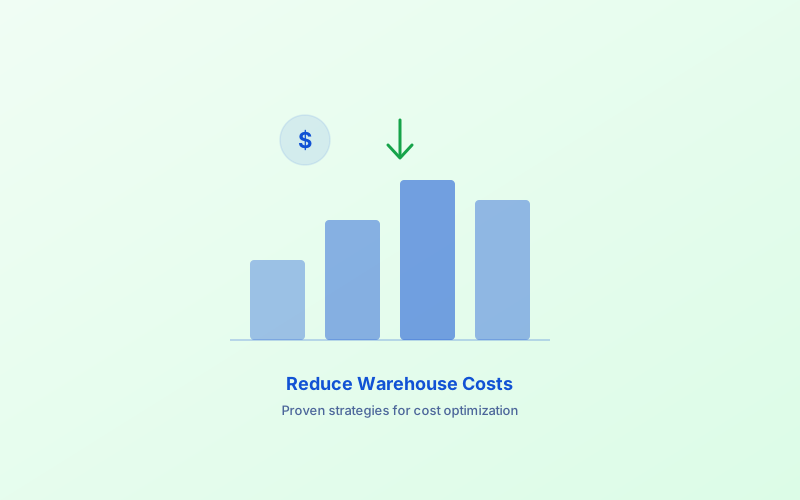
Warehouse operating costs have risen across rent, labor, energy, and day-to-day operational complexity. The challenge is simple: reduce costs without sacrificing the quality your clients expect. If you cut too aggressively, you increase errors, delays, returns, and downtime—costs that quietly erase your savings. The good news is that smart cost reduction is achievable when you focus on visibility, standardization, and the right automation. In this guide, you’ll learn 10 proven approaches to reduce warehouse operating costs efficiently—while keeping inventory accuracy, picking performance, and service quality on track.
1. Analyze Your Current Costs
Start by identifying where the money is actually going. Break down spending across labor, storage, handling, technology, and maintenance—then connect each cost to operational activities. Track error-related expenses too, such as rework, returns processing, and shipment corrections.
Practical insight: compare cost vs. volume by client, product type, and warehouse zone so you can see which drivers scale and which ones don’t.
2. Optimize Warehouse Layout
Reduce movement time by designing zones around flow. When fast-moving SKUs are stored closest to picking and packing, travel time drops—and throughput increases. Improving storage efficiency also helps you use capacity without constantly expanding floor space.
Use ABC analysis to allocate prime locations and keep aisles and signage consistent to reduce searching and mis-picks.
3. Use Warehouse Management Software
Manual spreadsheets and disconnected tools cause delays, inconsistencies, and preventable mistakes. Implement warehouse management software to standardize receiving, transfers, picks, and inventory updates.
Software also supports reporting, exception handling, and workflows that reduce manual effort and improve reliability.
4. Improve Inventory Accuracy
Inventory inaccuracy leads to overstock (wasted storage) and stockouts (missed sales and costly rush replenishment). Strengthen accuracy with cycle counting, clear location rules, and verification steps during receiving and picking.
Better demand planning also reduces purchasing spikes and helps you reduce logistics cost.
5. Automate Repetitive Tasks
Automation targets the work that consumes time but doesn’t create value: billing calculations, report generation, and routine stock tracking. When the system automates repetitive tasks, teams can focus on exception handling instead of data re-entry.
That’s how you reduce warehouse operating costs without harming service quality.
6. Train Staff for Efficiency
Training is a cost-control strategy. When staff understand SOPs and system workflows, errors go down and productivity improves. Equip teams with clear instructions for receiving, location setup, picking, packing, and handling exceptions.
Practical tip: run short weekly refreshers and measure improvements using accuracy and cycle-time trends.
7. Reduce Picking and Packing Errors
Picking errors create hidden costs through reshipping, customer support, product rework, and schedule disruption. Standardize pick paths, use verification checkpoints, and ensure packing steps align with order requirements.
A strong workflow reduces mistakes—so you can reduce costs while protecting delivery performance.
8. Monitor Key Performance Metrics
Decisions improve when you track the right KPIs. Monitor order accuracy, pick/pack cycle time, inventory accuracy, fill rate, and return reasons. Use these warehouse efficiency tips to spot bottlenecks and address them before they escalate into cost overruns.
Cost reduction becomes sustainable when you can measure it consistently.
9. Reduce Waste and Idle Inventory
Slow-moving inventory ties up cash and increases storage pressure. Identify products that aren’t turning and adjust replenishment frequency, storage placement, and reorder thresholds. Streamlined operations reduce idle inventory and protect warehouse efficiency.
When waste drops, your overall cost structure improves.
10. Scale Smartly with Technology
Scaling without control forces over-hiring, messy processes, and repeated rework. Instead of expanding manually, standardize operations and let technology handle complexity—inventory visibility, workflow automation, and reporting at scale.
If you’re ready to cut costs efficiently, request a demo to see how Warynx supports warehouse operations.
To plan your next step, view pricing plans and choose a solution that fits your warehouse cost goals.
Warynx Team
Sharing insights on warehouse management, inventory optimization, and operational efficiency.